
On this page
- What is the quick comparison?
- Why is aluminum the default?
- When does steel make sense?
- When does copper make sense?
- How does each handle winter?
- What about mixing metals?
- Which should you choose?
- What about vinyl and zinc?
- How do materials hold up to falling limbs?
- How long does each last?
- What does each cost over time?
- Does the material affect resale?
- How do you choose the color with aluminum?
- What do local homes usually get?
- Where should you go next?
What is the quick comparison?
| Aluminum | Steel | Copper | |
|---|---|---|---|
| Installed cost | About $9 to $13/ft (Angi) | Similar or higher (Angi) | About $25 to $40/ft (Angi) |
| Rust | Does not rust | Can rust at scratches and seams | Does not rust; develops patina |
| Dents | Dents more easily | Resists dents | Moderate |
| Weight | Light | Heavy | Moderate |
| Seamless | Yes, common | Possible | Possible |
| Joints | Sealed | Sealed | Soldered |
| Look | Painted, many colors | Painted | Bright, then brown, then green |
Why is aluminum the default?
It does not rust, it is light on the fascia, it comes in many colors and it can be formed seamless on site. For a typical rambler, split-level or new home around Falls Church, it is the best value. See aluminum gutters.
When does steel make sense?
Steel resists dents from ladders, limbs and hail better than aluminum. The trade-off is rust, especially where gutters hold damp leaves for weeks, which is common under the area's trees. Galvalume and similar coated steels last longer than plain galvanized.
When does copper make sense?
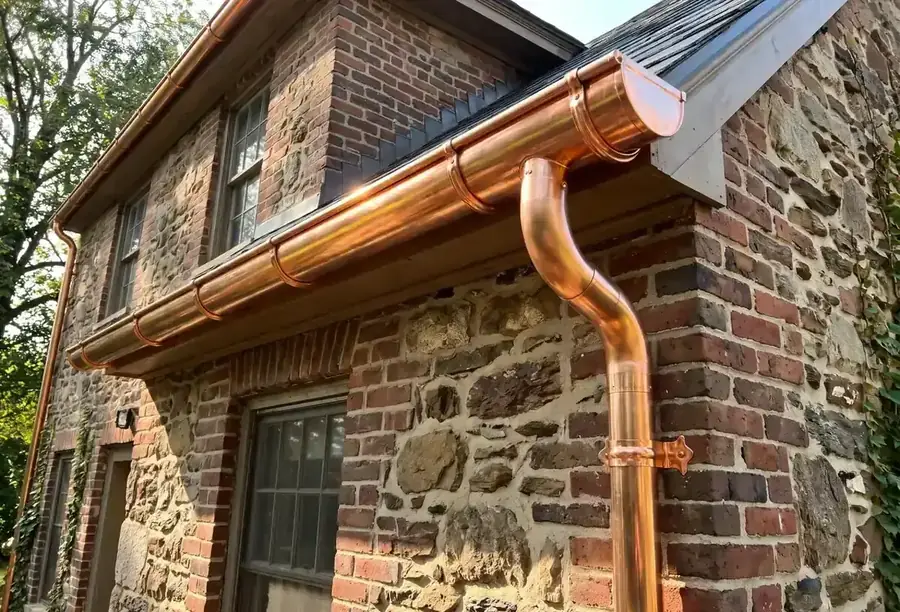
On older, historic and custom homes where looks matter and the owner plans to stay. The area has plenty of older houses, from the City of Falls Church, whose parish dates to 1734, to Alexandria's Old Town, the third historic district in the US. Copper half-round with round downspouts is the traditional choice on homes like these. See copper gutters.
How does each handle winter?
The area averages about 64 freezing nights and 13.7 inches of snow a year. All three metals cope if gutters are kept clear and hung on close-spaced hangers. The real winter risks are clogs that hold ice and hangers screwed into rotten wood, not the metal itself. Aluminum is the most likely to bend under heavy ice; steel and copper are stiffer.
What about mixing metals?
Copper reacts with aluminum and galvanized steel when they touch in the presence of water, and the aluminum or steel corrodes. Keep copper flashing, copper roof elements and aluminum gutters apart, or use compatible separators.
Which should you choose?
- Most homes: seamless aluminum, in a thickness that resists dents.
- Dent-prone spots under large trees: thicker aluminum or coated steel.
- Historic or high-end homes: copper, often half-round. See half-round gutters.
What about vinyl and zinc?
| Material | Notes |
|---|---|
| Vinyl | Cheap and DIY-friendly, but becomes brittle in cold and is sold in sections, not seamless |
| Zinc | Long-lasting, develops a gray patina, costs well above aluminum; uncommon locally |
| Galvalume steel | Steel with a coating that resists rust better than plain galvanized |
For a climate with about 64 freezing nights a year, vinyl's cold-weather brittleness is a real drawback.
How do materials hold up to falling limbs?
Heavy tree cover means limbs, nuts and branches land on gutters. Steel resists dents best, copper is moderately stiff, and aluminum dents most easily, though thicker coil narrows the gap. After big storms such as the 2012 derecho, the material matters less than whether a limb hits at all, which is why trimming overhanging branches is worth doing whatever the gutter.
How long does each last?
As a rough guide, painted aluminum often lasts two decades or more, coated steel varies with how well its coating holds up, and well-installed copper can last for generations. In every case, clogs, ice and rotten fascia shorten life more than the metal does.
What does each cost over time?
Copper costs several times more up front, roughly $25 to $40 a foot, against roughly $9 to $13 a foot for seamless aluminum. If you plan to stay a very long time in an older or high-end house, copper's lifespan narrows the gap. For most homes and most owners, aluminum gives the best value.
Does the material affect resale?
Copper can be a selling point on historic and custom homes. On most houses, buyers and inspectors care more that gutters drain, do not leak and are not sagging than what they are made of.
How do you choose the color with aluminum?
Match the trim for gutters that blend into the roofline, or match the brick or siding for downspouts that disappear. Black and dark bronze are popular on newer houses; white suits many older painted homes.
What do local homes usually get?
Around Falls Church, most ramblers, split-levels, townhouses and new infill homes get seamless aluminum in white, bronze or black. Copper shows up mainly on older and custom houses, including some in McLean and near historic districts in Alexandria and Fairfax. Steel is less common, used mostly where owners want extra dent resistance. Whatever the metal, the details of the installation, including slope, hanger spacing, sound fascia and downspout placement, decide how well the gutters perform more than the material does.
Where should you go next?
For most homes, read aluminum gutters and seamless gutters. For older or custom homes, read copper gutters and half-round gutters. Ask any contractor to quote the material you are leaning toward alongside one alternative, so you can see the price difference on your own house rather than relying on national averages.