
On this page
How is a seamless gutter made?
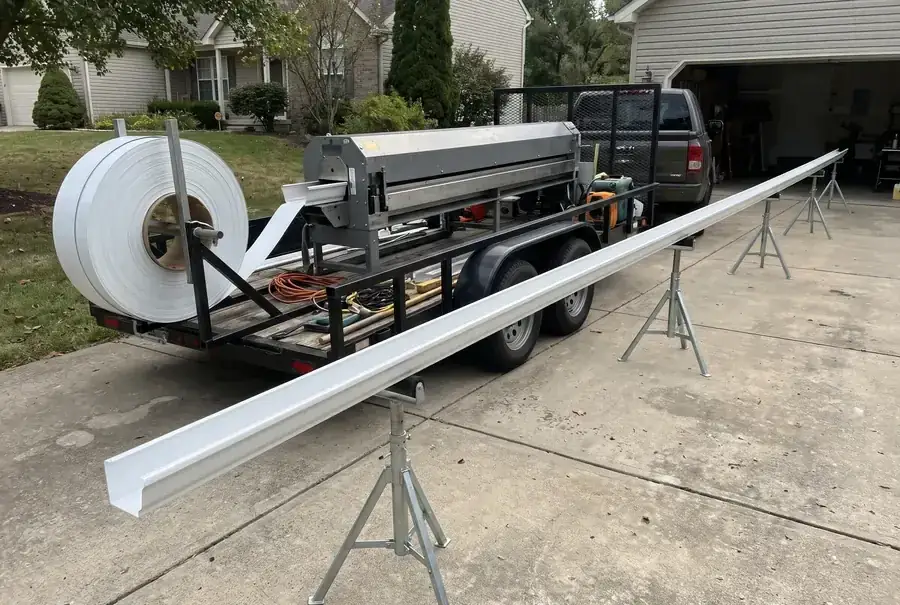
The contractor arrives with a trailer-mounted forming machine and a coil of flat, pre-painted metal. Each eave is measured, then the coil is fed through rollers that bend it into a gutter profile, usually K-style, and cut to length. The run goes straight from the machine onto the house. Corners are mitered and joined, end caps are fitted, and outlets are cut for downspouts.
Why do fewer seams matter here?
Sectional gutters are sold in short lengths, often 10 feet, and joined with connectors and sealant. Every joint is a place to leak. Around Falls Church, the area sees about 64 freezing nights a year, and each freeze and thaw pushes and pulls at sealant. Summer heat and the weight of wet leaves add to the strain. After enough years, many sectional systems drip at every joint.
A seamless run removes those joints from the straight stretches. What remains, at corners and end caps, is riveted and sealed, and those few joints are easy to check and reseal when needed.
What are the options?
| Choice | Common options | Notes |
|---|---|---|
| Size | 5-inch or 6-inch | 6-inch for large or steep roofs; see 6-inch gutters |
| Metal | Aluminum, steel, copper | See aluminum and copper |
| Thickness | Thicker coil resists dents | Worth it under trees and where ladders lean |
| Color | Many factory colors | Matched to trim, roof or brick |
| Hangers | Hidden hangers | Spaced closer for snow and leaves |
What does seamless cost?
National guides put seamless aluminum at roughly $9 to $13 a foot installed. Height, corners, downspouts, removal of the old gutters and fascia repair all change the total. The cost guide works through an example.
What else goes with a good seamless job?
- Sound fascia. Soft wood is replaced first, or the new gutter will pull away.
- Drip edge. Water should run off the roof into the trough, not behind it.
- Slope. An even fall toward each outlet so water does not sit and freeze.
- Downspouts. Enough of them, and carried away from the foundation. See downspouts.
Is seamless right for my house?
For most homes around Falls Church, yes. The exceptions are mostly about style: some older and historic houses look best with half-round gutters, which can also be made seamless in some cases or joined in longer lengths.
For the full comparison, see seamless vs sectional gutters.
What happens on installation day?
A typical seamless job around Falls Church follows a predictable order:
- Protecting the site. Drop cloths go over plantings and the crew sets ladders on stand-offs, not against the old gutters.
- Removing the old system. Gutters, spikes, hangers and downspouts come down and go into the truck. On older homes this is often the first chance in decades to see the fascia.
- Wood repair. Soft boards are cut out and replaced. Many postwar houses in West Falls Church and Pimmit Hills need at least a few feet.
- Measuring and forming. Each run is measured again and formed to length on the machine.
- Hanging. Hidden hangers go in about every two feet, and the run is set with a slight fall toward each outlet.
- Corners, end caps and outlets. These are the only joints, and they are riveted and sealed.
- Downspouts. Fastened to the wall and led away from the foundation.
- Water test. A hose shows that water reaches every outlet with nothing left standing.
Most single-family homes are finished in a day. Larger houses, complex roofs and heavy fascia repair can run longer.
How do you judge a seamless quote?
Two quotes for "seamless gutters" can describe very different jobs. Look for these details on paper:
| Item | A clear quote says | A vague quote says |
|---|---|---|
| Size | 5-inch or 6-inch, by elevation | "Gutters" |
| Metal | Material and thickness | "Aluminum" |
| Hangers | Type and spacing | Nothing |
| Downspouts | Count, size and discharge | "As needed" |
| Fascia | Price per foot or per board | "Extra if found" |
| Removal | Included, with haul-away | Not mentioned |
| Warranty | Workmanship term in writing | Verbal only |
What can go wrong with seamless gutters?
Seamless removes the joints along straight runs, but it does not remove every risk. The common failures are a corner miter that was sealed poorly, a run hung level instead of sloped, too few downspouts for a large roof, and hangers screwed into wood that was already soft. Each of those is a workmanship issue, which is why the contractor matters as much as the material. Virginia requires a state contractor's license for work of $1,000 or more, and most full installations pass that mark.